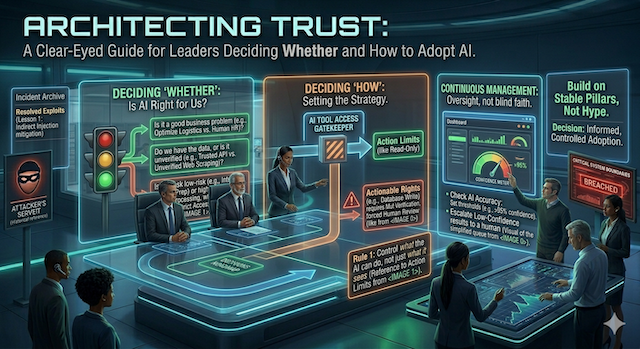
Decide whether AI is right for you, how to scope what it can do, and how to keep it under oversight.
You sign the contract, approve the budget, and answer for it when something breaks. But the AI tool is a black box, and the vendor's security answers reassure you without telling you much.
This guide fixes that. It gives you a simple framework for judging any AI tool or vendor, so you can tell a real answer from a hand-wave. No code required.
AraGrow
Executive Guide · AI Risk & Readiness
A Leader's Field Guide
Architecting Trust
A clear-eyed guide for leaders deciding whether and how to adopt AI. Plain language, not jargon.
What this guide is
Eight short parts that turn AI security into a set of decisions you can own. Built for the person who signs off, not the person who codes.
8Short parts
~90 minTo read
10+Hands-on labs
1Live assessment
0Lines of code
The spine of the guide
The Four Questions
Ask these of any AI system, yours or a vendor's.
What private data can it see?Inbox, customer records, contracts, files, databases. What's in reach?
Whose instructions can reach it?Only your staff, or also emails, web pages, and uploaded documents?
What can it actually do?Just answer, or send, book, pay, and delete?
Where must a human approve first?Which irreversible actions need a person to click "confirm"?
Every module returns to these four. By the end, you'll answer them in your sleep.
What you'll leave with
Six Ideas That Stick
The concepts that change how you decide.
The Lethal TrifectaPrivate data + untrusted content + the power to act = real breach risk.
The 95% RuleYou can't fully "solve" prompt injection, so architect for it, not around it.
Least PrivilegeGive the AI read access when it never needed write access.
Human-in-the-LoopA person confirms anything irreversible, every time.
The Dual-LLM PatternQuarantine untrusted input away from the tools that can act.
Measure, Don't VibeProve the system works with real evaluation, not a good feeling.
Inside the guideEight modules, one framework you'll keep