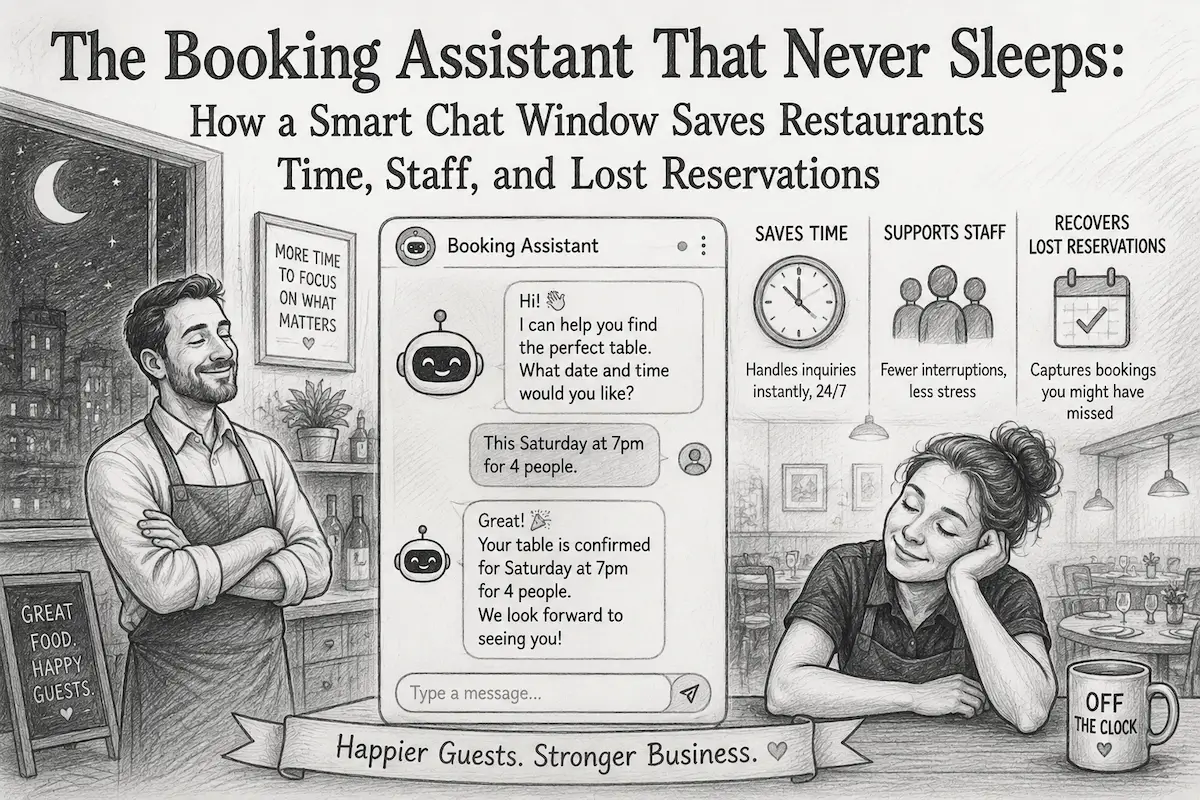
If your team spends half their shift answering "what time do you close?" and "do you have a table for four on Friday?" — there is a better way. Here's what a 24/7 virtual assistant looks like for a real restaurant, and why the same idea works for almost any service business.
The problem every restaurant owner already knows
Walk into any busy restaurant at 7pm and watch the host stand for ten minutes. You'll see the same scene play out over and over: the phone rings during a rush, a guest needs to be seated, the host has to choose. Most of the time the phone loses.
Every missed call is a coin flip on revenue. Some callers leave a voicemail. Most just hang up and try the place down the street.
And it's not only the calls. It's the WhatsApp messages at 11pm asking "are you open Sunday?" The Instagram DMs asking "is the salmon gluten-free?" The walk-in who wanted to cancel a Friday booking but couldn't get through. Every one of those is either a lost guest or unpaid work for someone on your team.
What this changes
Imagine a conversational assistant that lives wherever your guests already are — a chat window on your website, a WhatsApp message, a phone call, a link in your Instagram bio. The guest picks the channel that feels natural to them; the assistant is the same on all of them. Always staffed, always polite, and never having a bad day. It can:
- Take a reservation — checks the calendar, picks the right table for the party size, confirms it instantly.
- Reschedule or cancel — the guest doesn't need to "get through to someone." It just happens.
- Answer the daily questions — opening hours, dress code, parking, what's vegetarian, which dishes contain nuts, whether you accept walk-ins. Always the right answer, never made up.
- Take a complaint properly — logs the details, asks for the date, severity, what went wrong. No more lost feedback because the manager was busy.
- Speak the guest's language — if a tourist writes in French or German, the assistant answers in their language without you needing to translate your menu six times.
- Hand off to a human when it should — if the guest needs something the assistant can't handle, it offers your phone number directly, or texts a member of staff to call them back.
The honest framing for owners is this: it's not "AI replacing staff." It's removing the most boring, most repetitive minute-by-minute interruptions so the people you already pay can focus on guests in the room.
What it looks like for your guests
A guest opens your website on a Tuesday at 10:47pm and types:
"Hi, do you have a table for two tomorrow at 9pm? Anything quiet — it's an anniversary."
Within seconds, the assistant has confirmed the booking, suggested a quieter corner table, and asked if there are any allergies it should flag for the kitchen. The guest goes to bed happy. You wake up Wednesday morning with a confirmed reservation that — without the assistant — you would have lost completely.
Now imagine that same scene at lunch service the next day. A regular sends a WhatsApp message asking to move their Friday booking from 8 to 9. Instead of pulling your manager away from a full dining room, the assistant handles it, the calendar updates itself, and the guest gets a confirmation in 20 seconds.
That's the whole product, in two scenes.
What it means for your business
The benefits stack up quickly:
| What changes | Why it matters |
|---|---|
| Bookings captured 24/7 | The biggest single upside. Most reservation requests happen outside the hours your phone is staffed — evenings, late nights, Sunday mornings. Those bookings stop falling through the cracks. |
| Hours of staff time back, every week | Your host or manager stops being a switchboard. The repetitive questions go away; the guest in front of them gets full attention. |
| Fewer no-shows | Confirmations and reminders are automatic. The guest who would have forgotten about Friday gets a polite nudge. |
| Multilingual without the cost | You don't need a Spanish-speaking host or a French menu translation. The assistant handles it. |
| Cleaner customer feedback | Complaints arrive in a structured form — date, severity, what happened — instead of dribbling through a dozen channels. |
| Always on-brand | Tone, hours, policies, allergens — the assistant pulls from one source you control. No more "the new waiter told me you close at 10" mistakes. |
| Fewer mistakes at the host stand | No double-bookings, no "I thought I wrote it down." The assistant talks to your reservation system directly. |
You don't need to measure all of these on day one. Most owners feel the first two within the first week.
It's not just for restaurants
The same idea works almost anywhere your business runs on appointments and frequently asked questions. The wrapping changes; the engine doesn't.
| Business | What the assistant handles |
|---|---|
| Dental and medical clinics | Book / reschedule / cancel a visit, answer questions about insurance accepted and what to bring, send appointment reminders. |
| Hair salons and barber shops | Book with a specific stylist, answer service-and-pricing questions, manage cancellations and the cancellation policy. |
| Hotels and short-term rentals | Check room availability, modify a stay, answer questions about amenities, parking, and check-in times. |
| Auto repair shops | Book a service slot, give status updates on a vehicle, answer questions about pricing tiers and warranty. |
| HVAC and field service | Schedule a technician visit, share service-area information, give quote ranges. |
| Co-working spaces and event venues | Reserve a meeting room, list bookings, answer questions about equipment and rules. |
| Government and public services | Book a visit to a specific office, list required documents, share opening hours. |
If your business has a calendar and a frequently-asked-questions list, this works for you.
Built with care for your guests' privacy
Two questions every owner asks, in order:
"Can it accidentally tell a customer something it shouldn't?" No. Every reply passes through a privacy filter before it reaches the guest. Other customers' phone numbers, emails, and personal details are blocked automatically. The assistant only knows what's in your knowledge base — and if it doesn't know, it says so plainly instead of inventing an answer.
"Can someone book or cancel using a stranger's number?" No. Before changing or cancelling a reservation, the assistant asks the guest to prove the phone is theirs with a one-time code — the same way your bank confirms a login. New bookings still flow easily; only changes to an existing reservation need the extra step.
And nothing the assistant tells a guest is "winged." It only answers from a knowledge base you control. Updating the menu, the hours, or a policy is as simple as editing one document — the next conversation uses the new content.
It learns from your taste
Every assistant has good days and bad days. The difference here is that you get to coach it.
There's a simple review screen where you (or your manager) can flag a conversation as "good — keep doing this" or "bad — never reply like that again," with a one-line reason. Click a button, and from that point forward the assistant uses your examples as guidance. Over a few weeks of light review, the assistant ends up sounding like your restaurant — your voice, your standards, your judgement calls.
That feedback loop is the part most "AI chatbot" products get wrong. They feel generic forever. This one keeps getting closer to the way you'd answer the question yourself.
What it doesn't do — on purpose
A few things are intentionally outside the scope, so you know what you'd still handle yourself:
- It doesn't take payments. Bookings yes, money no. Pre-authorisations and deposits stay with your existing payment processor.
- It doesn't replace your team. When a conversation needs a human — a complicated complaint, a special request, a regular asking for a favour — it hands off cleanly with full context.
- It doesn't answer questions you haven't taught it. If the guest asks something not in your knowledge base, it says "let me put you in touch with the team" rather than guessing.
Those boundaries are by design. The product is a sharp tool for the boring 80% of customer conversations, leaving the interesting 20% to the people who actually run your floor.
Getting started
The setup for an existing restaurant is short and mostly content work, not technical work:
- Connect your reservation system. Whatever you already use to track tables and bookings becomes the source of truth. The assistant reads from and writes to it.
- Hand over your knowledge base. Menu, allergens, opening hours, dress code, cancellation policy, parking notes, anything you'd want a guest to be able to ask. We help you organise it on day one; you maintain it from there.
- Decide where the chat window lives. Your website is the obvious first home. WhatsApp, Instagram, and a dedicated short link are easy add-ons.
- Pick the languages you serve. The assistant ships speaking English, Spanish, French, German, Portuguese, and Italian. You write the menu once, in one language; it handles the rest.
- Run it for a week, then review. Read the conversations, mark the good ones and the bad ones, click rebuild. The assistant learns your taste.
Most restaurants are live within a few days. The slowest part is usually you giving us your real menu in a clean, edit-friendly format — and even that is a one-time cost.
If you'd like to watch this handle actual reservation requests, FAQ questions, and a cancellation — using a sample restaurant setup — I can walk you through it live in 15 minutes.
No slides, no pitch. Just the chat window doing its thing, then a conversation about whether it makes sense for your operation.
👉 Book your 15-minute walkthrough
The phone will keep ringing during your next service. The question is whether it has to keep being your problem.