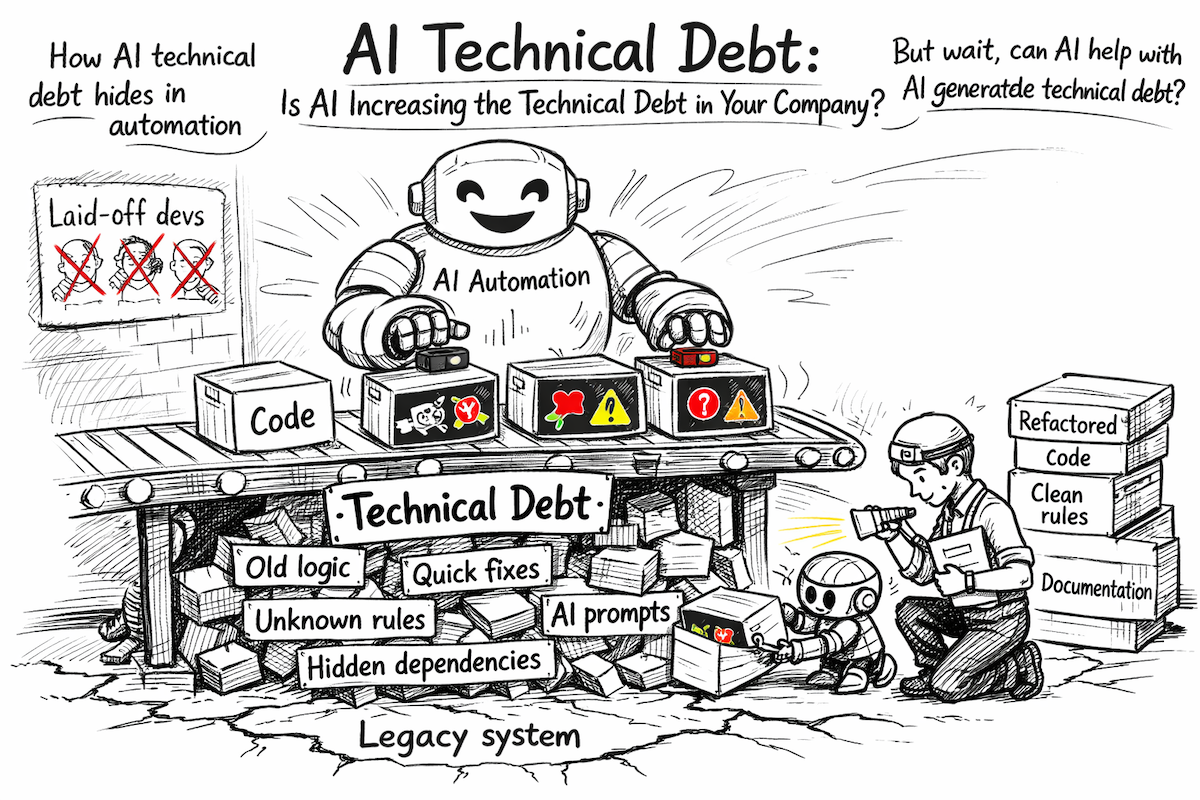
AI technical debt is quietly growing in a lot of companies, even as everyone celebrates how “smart” tools are saving time and money. AI now writes code, answers emails, and generates reports that used to take whole teams, but many leaders are starting to wonder if it’s really reducing complexity or just hiding new problems under the surface.
So what is Technical Debt
AI technical debt is the hidden complexity and long‑term maintenance cost created by quick AI‑driven solutions, prompts, and automations that aren’t fully understood, tested, or documented.
Is Technical Debt, the common Cold of Companies?
Before AI came along, companies already had something called technical debt. That’s just what happens when you pick the quick way instead of the right way. Over time, shortcuts and missing details start to slow you down. Every company has felt this.
I remember when I was a very junior programmer and a senior developer left our company suddenly. He was the only one who knew how the accounting system worked. He wrote the thing. We had to dig through old comments in the code to figure out logic that was never documented. Even worse, we had to learn the hard way that the little documentation we did have was outdated and just wrong.
One specific example was a process to purge some records. We noticed the system hadn’t been purged for years, and we were running into performance issues. That takes us back to the good old days when memory, storage, and processing power were expensive, so our manager proposed purging the system. We read the “User Guide,” and there, in black and white, was how to purge the system. We purged just one year, the oldest year, and that created a bunch of orphan records because the purge process did not account for some later enhancements. It took weeks just to fix the small bugs that the purge caused. That’s technical debt—the cost of lost knowledge.
The real problem was—and still is—that companies couldn’t or wouldn’t overlap the departing and new employees for more than a few days. There was no time to explain everything, and documenting each process by hand took forever. So people just kept moving and hoped nothing broke. Today, the real problem is that AI technical debt often appears only after something breaks.
Is Technical Debt similar to High Blood Pressure
AI technical debt is a lot like high blood pressure: most of the time, you don’t notice it until something serious goes wrong. On the surface, the system looks fine—tickets are closing, reports are generating, emails are going out, just like a person with high blood pressure can feel “normal” day to day. But underneath, small warning signs are already there: a trickle of odd edge‑case incidents after a new AI workflow launches, fuzzy ownership over who maintains a critical automation, or awkward silence when you ask, “What exactly does this AI workflow do, step by step?” Those are your elevated readings. Ignore them, and you’re quietly taking on risk that will eventually show up as a heart attack for your systems—a major failure that forces you to pay back all that hidden AI technical debt at once.
How AI technical debt hides in automation
AI technical debt often hides in automation because everything looks calm on the surface while the real complexity moves into prompts, workflows, and background services no one is really watching. It feels like magic: leaders see dashboards lighting up, tickets closing, emails answered, and code shipping faster than ever—so they assume the system is “self-managing.” But under the hood, you might have brittle prompt chains, hard‑coded assumptions, and silent dependencies on data sources that no one has documented. When something changes—a field in a form, a pricing rule, a data schema—the automation keeps running, confidently doing the wrong thing at scale. You don’t see the debt building until you start paying the interest in the form of bad tickets, wrong reports, or angry customers.
The risk gets worse when companies treat AI as a replacement for engineers instead of a tool for them. If you “code with no overseer”—letting AI generate workflows, code, and business rules while laying off the people who used to question and refine those decisions—you end up with systems no one fully understands or can safely change. The organization becomes dependent on the very automation it doesn’t know how to inspect, test, or refactor. On paper, costs drop because headcount is lower; in reality, you’ve traded salary expense for a growing pile of invisible AI technical debt that will be far more expensive to unwind later.
But wait, can AI help with the AI generated Technical Debt?
I’ve seen teams use AI tools to watch what developers do and create step-by-step documentation in minutes. For example, a service team used an AI assistant that listened during client onboarding meetings and spit out a clear checklist right afterward. Suddenly, the next new hire could follow along without having to shadow anyone for weeks. That kind of memory used to take hours to capture—but now it’s almost instant.
Still, it’s not perfect. With every new AI system comes new kinds of debt. These tools rely on models and data that can be tricky to maintain or understand. I’ve seen automation tools that looked amazing at first—until they started generating hundreds of wrong customer tickets because of one broken rule. Fixing that mess took days. So even though the system was “smart,” it created its own kind of hidden debt.
AI also makes it easy to trust documentation that looks polished but might miss small details. A machine might describe a process perfectly but forget that a human always double-checks something manually at the end. If nobody notices, that tiny step disappears from the workflow—and problems show up later.
So the truth is, AI doesn’t destroy or create technical debt—it moves it. Before, it lived in missing notes and memories. Now, it can live inside complex automation that people don’t fully understand. The difference is that this kind of debt is fixable if you keep humans in the loop.
The real question isn’t “Is AI increasing your technical debt?” It’s “Are you using AI to manage your company’s memory?” If you use it carefully, with people reviewing what machines produce, you’ll probably cut more debt than you create. But if you rush, you might end up swapping one kind of confusion for another.
Because in the end, AI’s greatest gift is helping us remember. And if we use that right, we won’t just avoid or reduce technical debt, we’ll make sure the wisdom in our teams never disappears again. Handled well, AI technical debt can actually be reduced over time.