
Why do I care to have an AEO and GEO Navigation Strategy? Your website menu is invisible when it works well. But it’s becoming increasingly important for a new reason: artificial intelligence now reads your menu to understand your business.
ChatGPT, Google AI Overviews, and other answer engines are changing how people find companies. When someone asks these AI tools a question, the AI reads hundreds of websites to find answers. Your menu is one of the first things the AI looks at to understand what you offer.
The problem is simple. Most website menus don’t help AI understand your business. They were designed only for visitors.
A Navigation Issue I Found in the Wild
This post is based on a real issue recently uncovered by my internal tool WarpInsights while analyzing one of my current clients.
Their website navigation was extremely simple—just three menu items. It made sense for human visitors, but it created problems for AI and agentic search systems. Despite the clean design, AI struggled to understand the client’s purpose, services, and how pages related to each other.
I used AI to research the potential drawbacks of overly simple navigation, and the findings were consistent: answer engines and agents need more structure and context to accurately interpret a business. When that context is missing, visibility suffers.
The recommendation was straightforward: instate a AEO and GEO Navigation Strategy by keeping the navigation simple for users, but introducing a clear, multi-level structure that better communicates services and intent to AI.
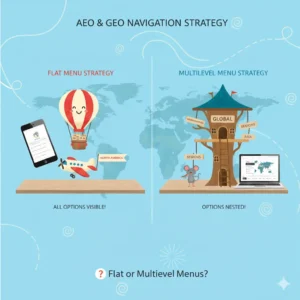
Simple Menus Leave Money on the Table
Many websites use a flat menu structure. Think SERVICES | BLOG | CONTACT. It looks clean and uncluttered.
But this simplicity comes with a cost. When you label everything as “SERVICES” without organizing them into categories, the AI cannot tell the difference between your offerings. It doesn’t know if you write blog posts, product descriptions, email campaigns, or all three.
Here’s what happens in the real world. A potential customer asks an AI tool: “Who can write product descriptions for my e-commerce store?” The AI reads your website. It sees “SERVICES” but has no organized information about product descriptions specifically. So the AI recommends a competitor who has a clearer menu structure.
You lose the business because your menu was too simple.
Organized Menus Win with AI
Now imagine a different menu structure. Instead of a single “SERVICES” link, your menu shows:
- Content Creation (with sub-options like Blog Writing, Email Marketing, SEO Content)
- E-Commerce Services (with sub-options like Product Descriptions, Category Pages)
- Marketing Management (with sub-options like HubSpot Services, Case Studies)
This organized approach does something powerful. It tells the AI exactly what you offer and how your services relate to each other.
When that same potential customer asks “Who can write product descriptions for my e-commerce store?” the AI now reads your organized menu. It sees that you offer e-commerce services and specifically product descriptions. The AI recommends you because your structure proves you specialize in exactly what they need.
You get the customer because your menu was clear and organized.
What a Search & AI-Friendly Navigation Strategy Signals to AI
A well-structured menu tells AI four important things about your business.
- It shows that you offer multiple services. An organized menu proves you are not a one-service company. You have depth and expertise across different areas.
- It demonstrates that you serve different types of customers. When your menu includes sections like “For E-Commerce Brands” and “For Agencies,” the AI understands that you have specialized solutions for different customer groups.
- A clear and organized menu signals professionalism. Messy and confusing menus look unprofessional to both humans and AI. A structured menu tells the AI that you are competent and organized.
- An organized menu shows that your services and content are related. When blog writing, email marketing, and SEO content are grouped together, the AI recognizes them as related topics. This makes your entire website look more authoritative to AI tools.
AEO and GEO Navigation Strategy Benefit: More Visibility with AI Search
You want AI tools to recommend your business when potential customers search for your services. An organized menu structure does exactly that. It tells AI what you offer and who you serve, making it easy for the system to match your business with the right search queries. A flat menu might look cleaner, but if AI can’t understand your services, you’ll be invisible to the fastest-growing way people find businesses today. Your competitors are already building organized menus. If you don’t, you’ll fall behind.
A Tool to the rescue
Now you’re juggling SEO, AEO, GEO, analytics, performance, rankings, competitors, and site structure—across Google Analytics, Search Console, PageSpeed, SEMrush, Ahrefs, Moz, and more. That’s too many tabs and too much data.
WarpInsights fixes this. It pulls everything into one dashboard. Instead of jumping between tools, you ask one question in plain English:
It’s especially powerful for navigation optimization. If you reorganize your menu for AI discovery, WarpInsights shows whether it’s working. It reveals how AI sees your site, which pages are easy to find, and which are buried. It flags unclear service pages and structural issues.
Without it, this takes hours every week. With WarpInsights, it takes minutes.
Over time, it tracks impact. You see when navigation changes improve AI visibility, rankings, and authority.